
Russian Manicure E-File Control: Why RPM Alone Is Not Enough
RPM is only one of the variables that determine how an e-file behaves during Russian Manicure. Pressure, movement, contact point, bit angle, stabilisation, hand positions, visibility and workspace all influence the result, and the same RPM can behave very differently when any of them changes.
For that reason, e-file control cannot be learned as a number to memorise. It is better understood as a system in which each variable affects the others, so that adjustments are deliberate rather than copied. This article explains the cause and effect behind that system. It is educational and is not a recipe: it does not give settings to follow.
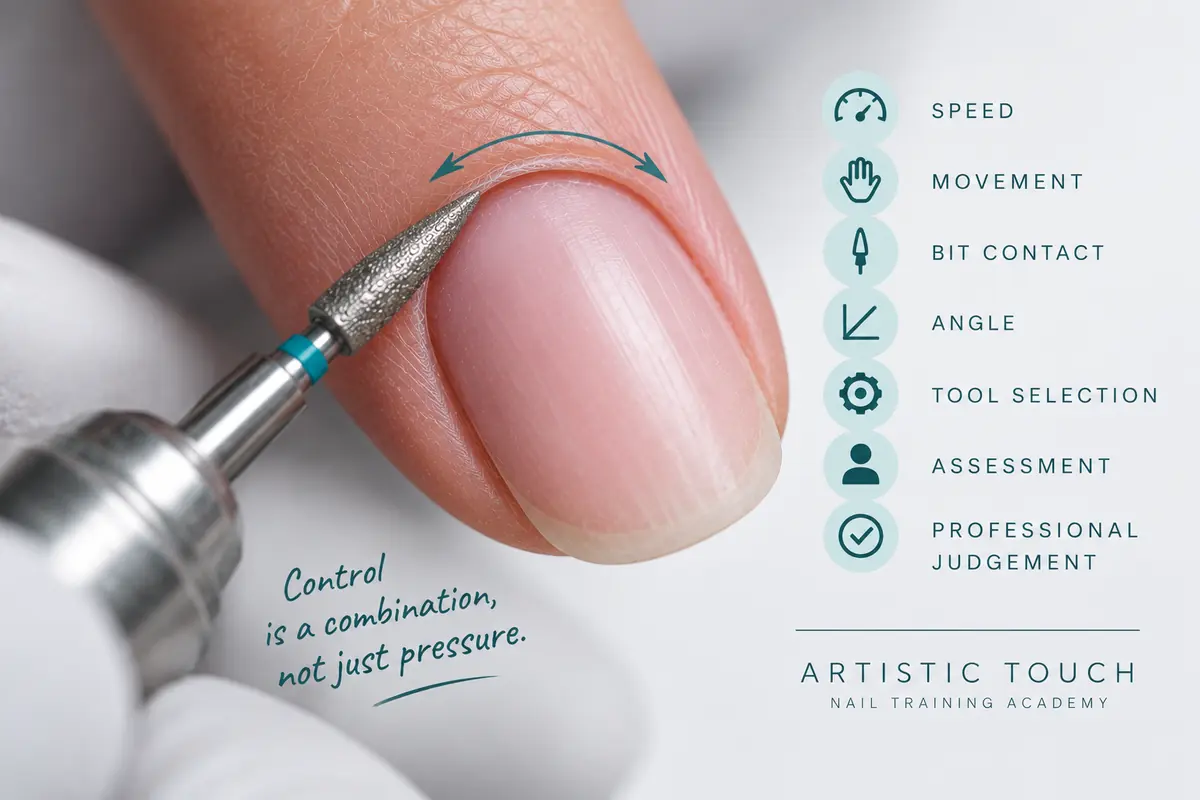
Why RPM Is the Question Everyone Asks
When technicians learn Russian Manicure, the first question is often which speed to use. It is an understandable question. A number is simple to ask for, simple to give and simple to copy from a demonstration. The difficulty is that a number describes only one part of what is happening at the point where the bit meets the tissue.
A technician who has learned a speed without learning what surrounds it has learned an instruction that works in the situation in which it was demonstrated and may not work in the next one. The aim of this article is to replace the question "Which RPM?" with the more useful question: "What is the bit doing, and why?"
What RPM Does and Does Not Tell You
RPM states how fast the bit rotates. Speed matters, because it affects how much friction and heat is generated. What it does not describe is how the bit is meeting the tissue, how steadily the hand is moving, how well the technician can see, or how the machine behaves when it meets resistance.
The last point is worth remembering when comparing equipment. In a side-by-side test of two e-files that advertised the same maximum speed, Radina Ignatova found that they differed in how well they maintained power under load, how much they vibrated and how warm the handpiece became. That test involved product removal rather than manicure work, but it illustrates the principle that the same advertised speed does not guarantee the same behaviour. The full comparison is in JD700 vs Saeyang K35 E-File Comparison: Same 30,000 RPM – Not the Same Power. For general background on equipment, see TheNailWiki guide to the e-file machine.
The Variables That Work Together
Several variables act at once. Understanding each one separately makes it easier to see how they combine.
Pressure
"Use light pressure" is common advice, and it is not wrong, but it is incomplete. Pressure stands in for several things at once: how firmly the bit meets the tissue, how steadily the hand moves, how long the bit stays in one place, and how actively the technician adjusts in response to what they feel. A light touch with an unsteady hand can still cause a problem, and a firmer touch with a steady, continuous movement may remain controlled. "Light" is therefore not a reliable measure on its own. What counts as appropriate also depends on the tissue assessed at the start of the service, since thinner or more delicate tissue calls for a different standard from tissue that is thicker or more resistant.
Movement
A bit that keeps moving behaves differently from a bit that lingers. Repeating the same spot without noticing, or hesitating mid-movement, changes how much friction and heat the tissue receives, whatever the speed. Steady, deliberate movement is part of control, and it depends on the stability described below.
Contact point and bit angle
A flame bit is not a single point. It has a shape, and the part of that shape that touches the tissue is its contact point. Changing the angle changes which part of the bit is doing the work, so angle is better understood through contact point than remembered as a fixed number. The finger is also curved rather than flat, so the same wrist position does not meet the surface in the same way at every point along it. Contact point is therefore a decision that is adjusted continuously as the hand moves.
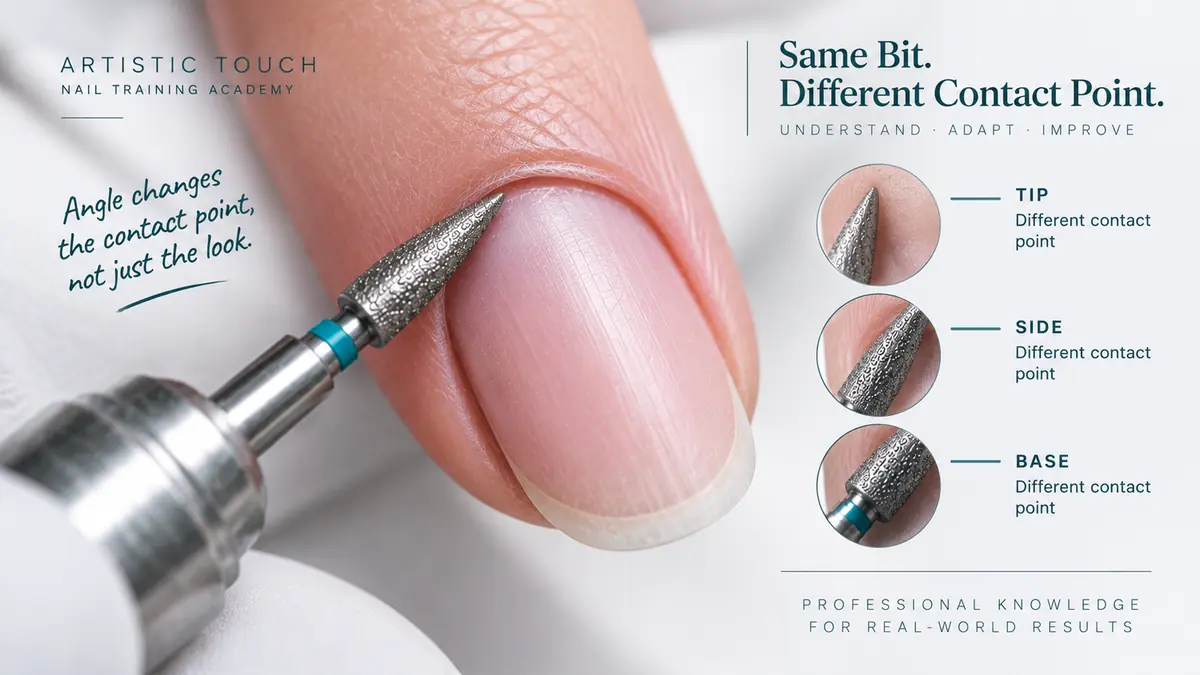
The Artistic Touch article Russian Manicure Bit Angle: What Changes When Your Contact Point Changes? explains this in more detail.
Stabilisation
Stability affects every other variable. If the client's finger moves, or the technician's own hand is not supported, the contact point shifts and pressure varies, however carefully each was set at the start. Muscle fatigue and tension in the grip also transfer into variation in pressure during movement. Stabilising both the client's finger and the technician's own hand therefore supports control rather than being a separate matter of comfort.
Technician hand position and client hand position
Where each hand is placed determines the angles that are available and the amount of strain the technician carries. Repositioning the client's hand, rather than twisting the technician's own body, keeps the working area in clear view and allows the technician's hand to stay in a stable, neutral position. A relaxed client finger also matters: a finger that tenses or angles away can block visibility.
Visibility and workspace positioning
Visibility is a precondition for control. Chair and working height, support for the forearm and elbow, lighting and working distance all affect how clearly the technician can see what the bit is touching. Poor ergonomics reduces visibility, undermines pressure control, compromises stability and slows the work, and over time contributes to strain. For this reason, workspace set-up is part of technical control, not an addition to it.
Cause and Effect: Why the Same RPM Behaves Differently
Because the variables interact, a change in one alters the effect of the others. The following relationships illustrate the point. They describe how variables influence each other, not settings to use.
- Angle affects pressure. A change in angle alters how much pressure is transmitted to the tissue, so the same hand force can feel and behave differently at a different angle.
- Speed affects friction and heat. A higher speed generates more friction and heat for the same contact, which is why raising speed without control creates more risk than benefit.
- Direction affects visibility. The direction of the work determines which structures are being approached and whether the technician keeps a clear view of them.
- Stability affects contact. An unstable hand or finger changes the contact point from moment to moment, so the effective pressure varies even if the intended pressure does not.
- Tissue affects all of them. The same combination can feel different on thin, delicate tissue and on thicker, more resistant tissue.
This is why the same RPM can behave very differently when pressure, angle, contact or stabilisation changes. The speed has not changed, but its effect has.
Treating Symptoms Instead of Causes
When a problem appears, the instinctive response is often to change the most visible variable. That response frequently treats a symptom, not the cause.
- Increasing speed to compensate for poor visibility does not improve visibility.
- Pressing harder because the pocket has not opened does not open it.
- Switching tools when the real issue lies in positioning or contact leaves the underlying issue in place.
- Working more deeply into the nail sinuses because they are hard to see usually overlooks the actual issue, which is typically visibility or positioning rather than depth.
In each case the useful response is to ask what is really causing the difficulty: the view, the position, the angle, the contact or the tool. The same reasoning applies to equipment that catches or snags, which is discussed in TheNailWiki article on e-file glove catches.
Why This Cannot Be Reduced to a Recipe
Two further reasons prevent e-file control from becoming a recipe. The first is that the tissue changes from client to client. A combination of speed, pressure and contact that suits one hand may not suit another, so the assessment made before the e-file is switched on is as much a part of control as the movement itself. This is examined across different clients in Why One Russian Manicure Routine Does Not Work for Every Client.
The second is the condition and choice of the bit. Shape, diameter and abrasiveness all change how a tool interacts with the tissue, and a worn or unsuitable bit affects control whatever the technician's technique. Choosing a tool is a response to what the tissue and the task require, not a fixed default. The foundations of the technique are set out in What Is Russian Manicure? A Professional Guide for Nail Technicians.
Developing Deliberate Control
Understanding how the variables interact is a useful beginning, but physical control develops through practice. What understanding changes is the quality of that practice. A technician who knows what each variable does can practise towards a clear aim, and can diagnose a difficulty by asking which variable is responsible, instead of repeating a movement and hoping for a different outcome.
Technicians who want to develop deliberate e-file control rather than memorise settings can study the subject in depth inside Russian Manicure – Beyond Technique. Module 3, E-File Control, Hand Position and Ergonomics, connects speed, pressure, movement, contact point, bit angle, stabilisation, technician position, client position, workspace and visibility, and a following module covers tool selection and professional care. Radina Ignatova created the course, and Artistic Touch Nail Training Academy delivers it online for study at the student's own pace. Basic e-file experience is the recommended starting point, and no earlier Russian Manicure training is needed. The course is also described in the launch announcement.
Study e-file control in Russian Manicure – Beyond Technique
Frequently Asked Questions
What RPM should I use for Russian Manicure?
There is no single figure that suits every technician, bit and client. Speed is one variable among several, and its effect depends on pressure, movement, contact point, angle, stabilisation and the tissue being worked on.
Does a higher speed make Russian Manicure faster or better?
Not automatically. A higher speed generates more friction and heat, and it does not compensate for poor visibility or positioning. Efficiency comes mainly from good assessment, positioning and fewer unnecessary movements.
Is light pressure always the right advice?
It is a sensible warning but an incomplete instruction. Pressure works together with movement, contact and angle, and what counts as appropriate depends on the client's tissue.
Why does the same technique feel different on different clients?
Tissue is not uniform. Its thickness, hydration and sensitivity, and the depth of the cuticle pocket, all alter how the same movement behaves, so identical settings can feel different from one hand to the next.
This article explains principles of e-file control for professional education. It is not a technical procedure, it gives no settings to follow and it does not replace training. Russian Manicure should be performed only by trained professionals who work within current hygiene and safety requirements.