
Why One Russian Manicure Routine Does Not Work for Every Client
A single Russian Manicure routine does not suit every client because the tissue the technician is working on differs from one client to the next. Skin hydration, skin thickness, sensitivity, the depth of the cuticle pocket and the flexibility of the proximal nail fold all vary, and each of these changes what is appropriate in terms of control, tool choice and handling.
The aim is not to memorise a separate routine for every client. It is to understand how and why your decisions change when the tissue changes. This article sets out that principle, Different Client. Different Decision., and applies it to four kinds of client: normal skin with shallower cuticle pockets, dry overgrown cuticle, thin skin and sensitive skin.
The Sequence Is Useful, but It Does Not Make the Decision
Most technicians learn Russian Manicure as a sequence: a set order of steps that gives a clean result when followed correctly. That is a reasonable and necessary place to begin, and a structured sequence is useful because it describes the general order of the work.
What a sequence cannot do is tell a technician whether a particular step is appropriate for the client in the chair, or how to adapt when the tissue differs from the one that was demonstrated. The sequence stays the same. The client does not. A technician who relies on the sequence alone is likely to apply the same pressure, the same depth and the same amount of work to every hand, and it is the difference between trained and professional that decides what happens next: a trained technician knows the steps, and a professional technician understands the anatomy and adapts the steps to what is in front of them. The foundations of the technique are explained in What Is Russian Manicure? A Professional Guide for Nail Technicians.
What Differs Between Clients
Several features of the anatomy and the tissue vary from client to client, and each influences the decisions that follow.
- The proximal nail fold. Some folds are soft and flexible and lift easily. Others are firmer and resist opening. Where a fold does not lift readily, applying more pressure is not the answer; the depth of work should follow what the anatomy allows.
- The cuticle pocket. Some pockets are naturally deep and open easily, while others are naturally shallow and do not open significantly. This is a feature of the client's anatomy, not a failure of technique.
- The nail sinuses and lateral structures. These differ in how wide, tight or accessible they are, and therefore in how much visibility the technician has.
- The condition of the skin. Hydration, thickness, resilience and sensitivity all vary, and they can change on the same client from one appointment to another.
The distinction between true cuticle and the living eponychium also matters here. TheNailWiki explains it in The Eponychium and Cuticle.
Reading the Tissue Before Choosing the Approach
Assessment comes before the choice of tool, speed or pressure. Before picking up the e-file, a technician should look deliberately at a small number of things: whether the tissue appears dry or more hydrated; whether it looks thin and delicate or thicker and more resistant; how far the cuticle has grown over the plate; and how the surrounding skin looks, including whether it already appears calm or slightly irritated. A light initial touch can add information about how the tissue responds.
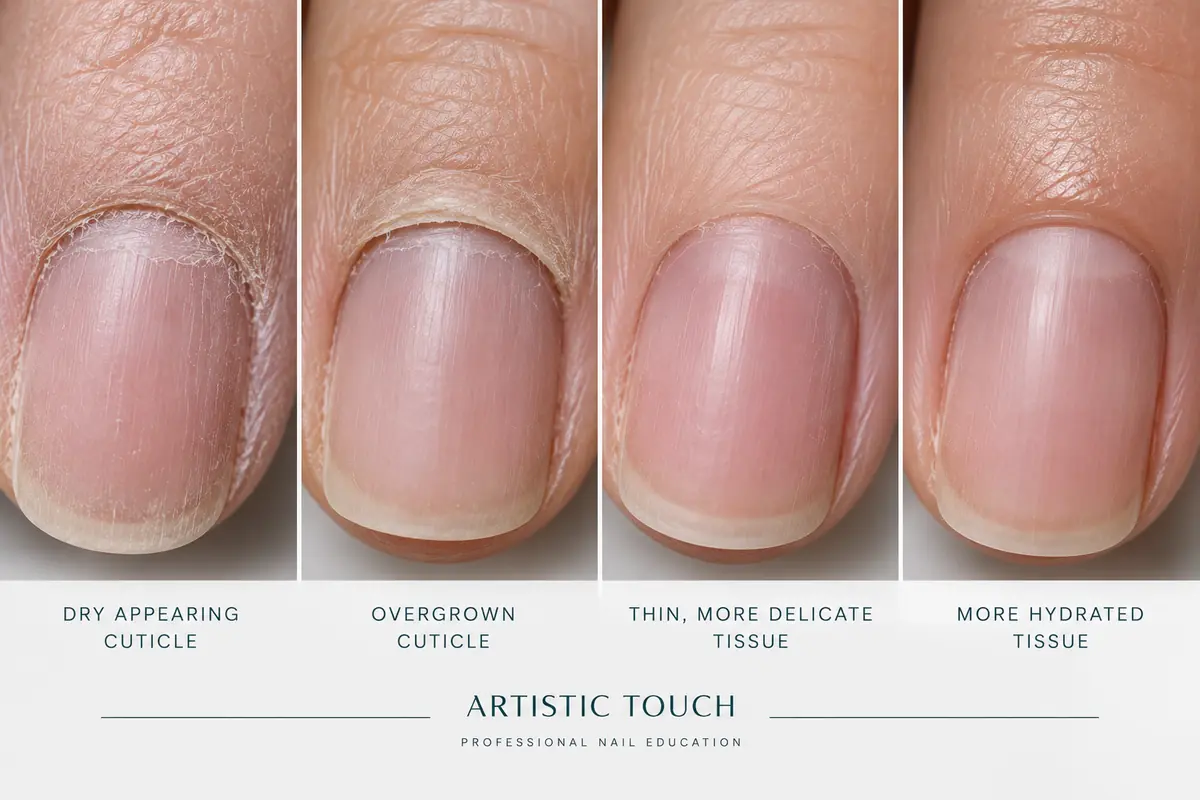
Two observations deserve particular care. Dry or overgrown cuticle does not automatically mean "work more": dry tissue treated identically to any other tissue is not guaranteed to respond in the same way, and overgrowth tells you how much surface the cuticle covers, not whether it is thick and resistant or thin and delicate. These are separate questions that can lead to different decisions. The reasoning is set out in the Artistic Touch article How to Read the Cuticle Before Russian Manicure.
Four Real-Client Cases
The following four cases are the ones taught through real-client demonstrations in Russian Manicure – Beyond Technique. They are described here for their reasoning, not as separate routines to memorise.
Normal skin with shallower cuticle pockets
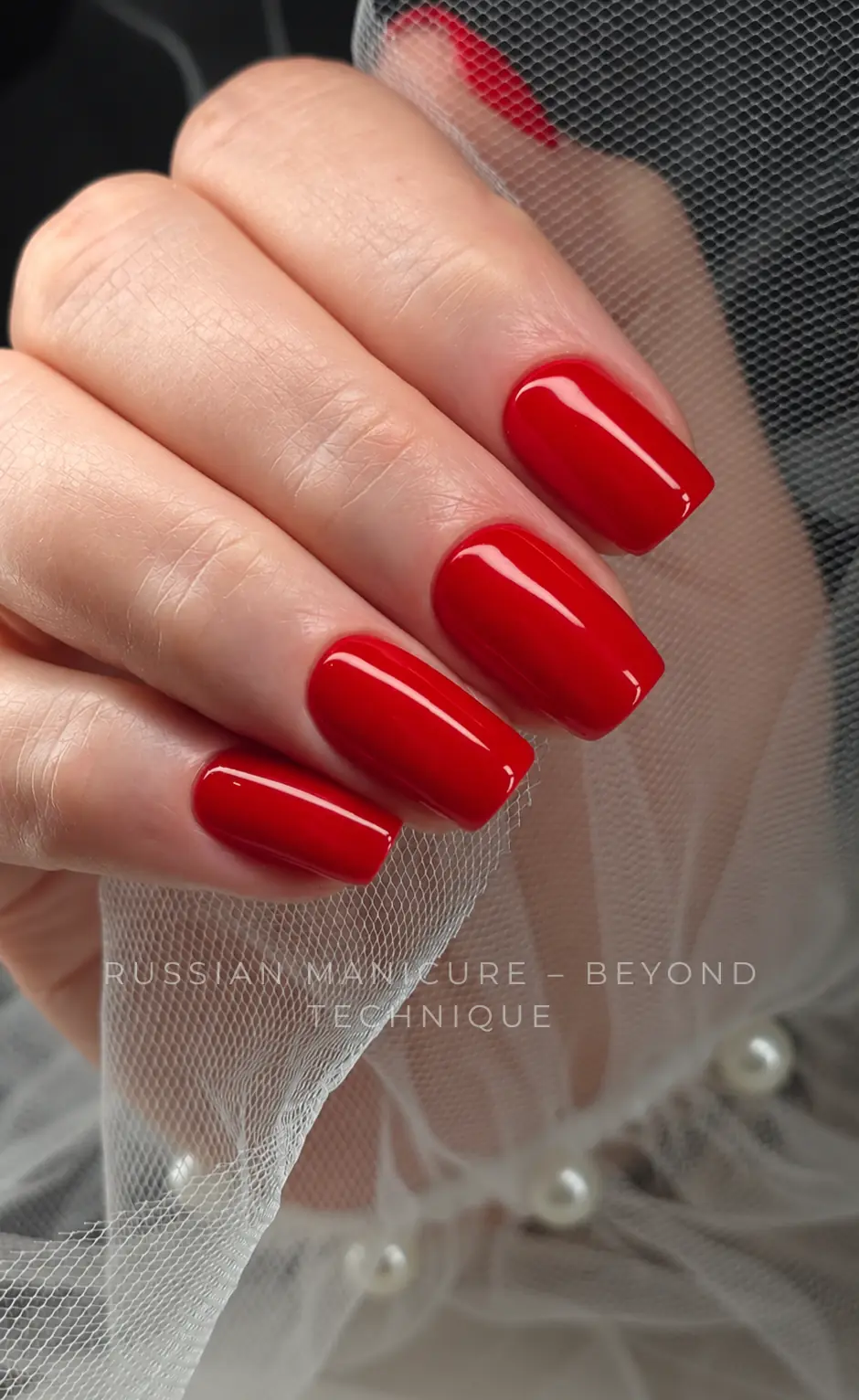
A shallow pocket is a feature of anatomy. It means that the deep, heavily filled appearance sometimes seen online cannot be achieved without forcing tissue that is not meant to be forced. Many of those images come from models who sit for much longer than a normal appointment allows, so they are not a fair standard for a working salon. In this case the pocket needs opening and little else: there may be minimal true cuticle to remove and little dry skin along the sides, and the aim is to trim only what has actually grown since the previous appointment. Tool choice responds to the same facts. A bullet-shaped flame bit, noticeably thicker than a standard flame, was chosen for one such client because it opened the fold more efficiently for that pocket. The Artistic Touch article Shallow Cuticle Pocket? This Changes Your Russian Manicure describes the case.
Dry overgrown cuticle
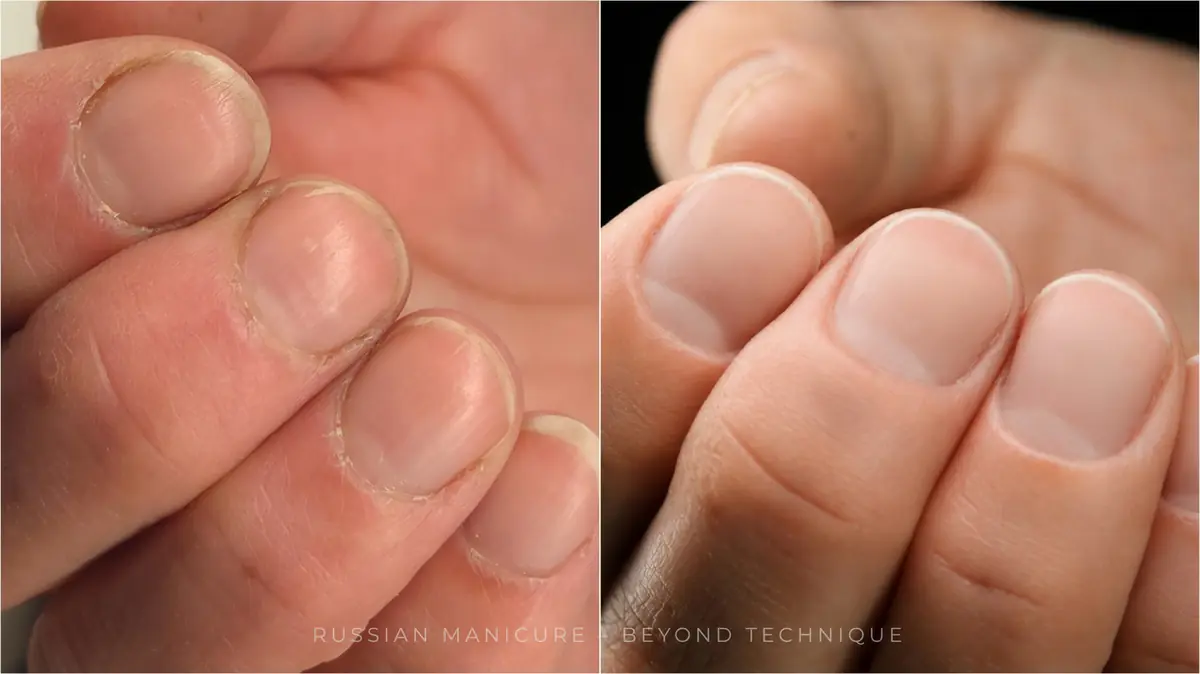
Dry, overgrown tissue calls for restraint and patience. Very dry cuticle can separate unpredictably and hide what lies beneath, so cutting deeper in an attempt to remove everything in one pass raises the chance of working into tissue whose condition is not clear. Trimming only the clearly dry sections and exfoliating carefully is generally the more cautious sequence. Opening the fold gently before any e-file work begins is the same safety step whatever the difficulty of the case. The honest goal for a first appointment on tissue like this is a realistic improvement, built on over regular visits and consistent aftercare, not a perfect result in a single session. Adjustments made for one client, such as additional passes of exfoliation for unusually tough skin, are deliberate responses to that tissue and not general recommendations. The case is described in Russian Manicure on Overgrown, Dry Cuticles: A Real Client Case.
Thin skin
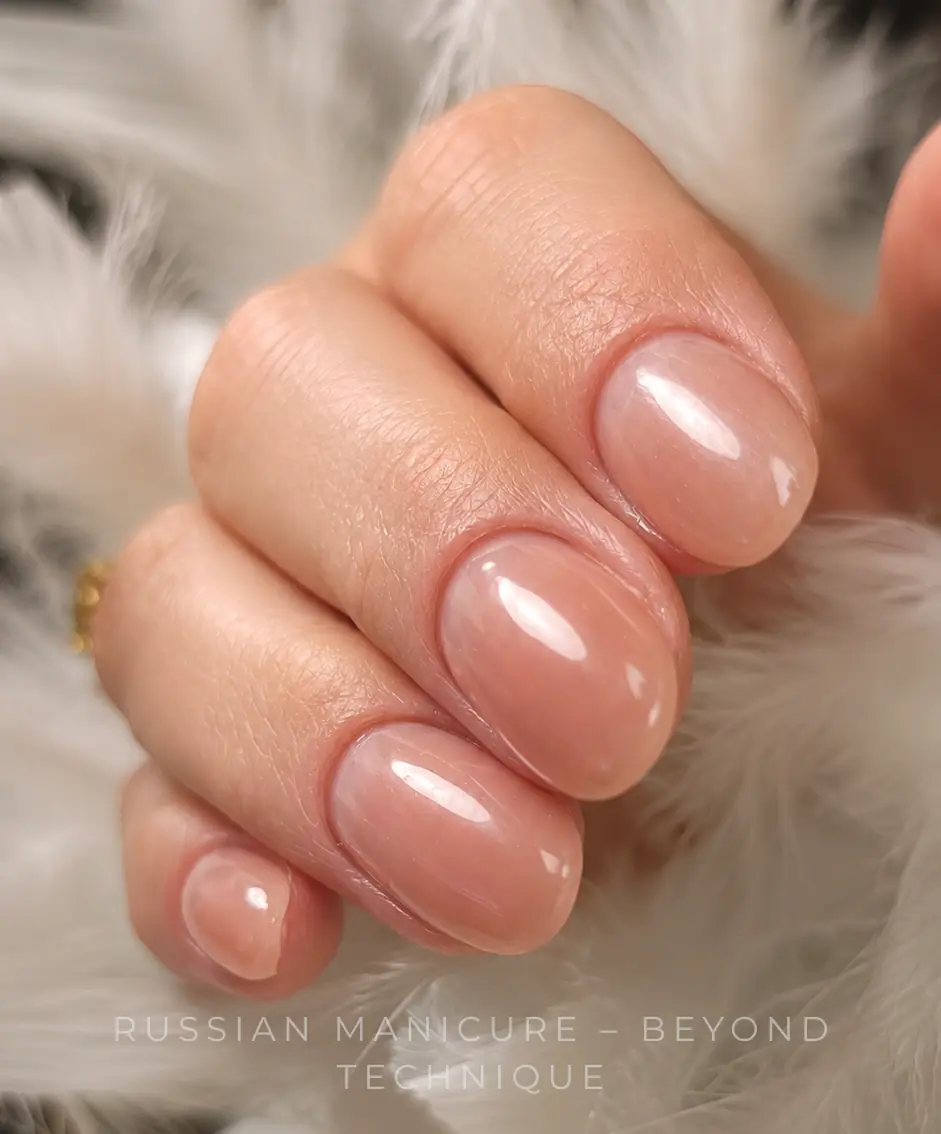
Thin skin is a delicate case. The margin between comfortable and uncomfortable is narrower, so greater control and lighter handling are needed. Restraint matters here: fewer, more accurate movements can give a better result than repeated refinement of the same area. The tissue should also be assessed as the service progresses, because its response is part of the information that guides the next decision.
Sensitive skin
Sensitive skin is also a delicate case that calls for careful control. The most useful moment to notice sensitivity is before contact, through the appearance of the tissue and its response to a light initial touch, not after a flinch, a comment or redness part-way through the service. Recognising early that the margin is narrower allows the technician to adjust handling and approach, rather than discovering the margin by crossing it. This does not mean avoiding the area or working so cautiously that the result suffers; it means adapting.
Why Control, Tool Choice and Handling Change
Across the four cases the same questions recur, and the answers differ.
- Control. How steadily and how deliberately the hand needs to work depends on the tissue. Tissue that is thin, dry or sensitive leaves less room for variation.
- Tool choice. The shape, size and abrasiveness of a bit affect how it interacts with the tissue, so what suits one pocket or one skin type may not suit another. Fewer tools used more purposefully can also be a deliberate choice.
- Pressure and handling. What counts as appropriate pressure has to be judged against the tissue assessed at the start. Pressure works together with movement, contact point and angle, as discussed in Russian Manicure E-File Control: Why RPM Alone Is Not Enough.
- Assessment before action. The technician decides what to do after seeing what is there, not before.
The Same Visual Target Should Not Mean the Same Process
A technician may be aiming for a similar finished appearance on every client: a clean, even edge around the nail and a neat coating. Reaching that appearance on different tissue does not require the same process. A client with a shallow pocket and little overgrowth may need very little work, while a client with dry, overgrown cuticle may need a staged approach over more than one appointment.
Judging every result against one idealised image leads to the wrong decisions. It encourages forcing a deep pocket where the anatomy does not allow it, or continuing to work because a small flake remains visible under magnification. Knowing when to stop is part of professional judgement, because further work can add risk without adding value. The result should be judged by whether the work suited the client, as well as by how it looks.
Learning Decisions, Not Four Routines
It would be a mistake to read the four cases as four routines to learn by heart. The point is that each case shows the same principles producing different decisions because the tissue is different. A technician who understands what they are looking at, how the tissue differs, why control needs to change and why tool choice may change can apply that reasoning to a fifth and a sixth client who match none of the examples. The aim is not to memorise a separate routine for every client. It is to understand how and why your decisions change when the tissue changes.
See the Reasoning Applied
Reading about the principle is a start, but seeing it applied across real tissue shows how the decisions are made. Technicians who want to watch this reasoning demonstrated, and not only read about it, can do so in the real-client demonstrations in Russian Manicure – Beyond Technique. Module 6, Real Clients. Different Skin. Different Decisions., shows how the same Russian Manicure principles are adapted across the four clients described above. Radina Ignatova created the course, which Artistic Touch Nail Training Academy delivers online for self-paced study. Students do not need to have trained in Russian Manicure before, although basic e-file experience is recommended. See also the launch announcement.
See the real-client demonstrations in Russian Manicure – Beyond Technique
Frequently Asked Questions
Why does the same Russian Manicure technique work differently on different clients?
The technique is applied to tissue that varies. Skin hydration, thickness, sensitivity, pocket depth and the flexibility of the proximal nail fold all change how the same movement behaves and what is appropriate.
Is a shallow cuticle pocket a sign of poor technique?
No. Pocket depth is a feature of the client's anatomy. Adapting the depth of work, the choice of tool and the approach to what the anatomy allows is a normal part of professional work.
Should dry or overgrown cuticle simply be worked on for longer?
Not automatically. Dry or overgrown tissue should be assessed first, because dryness and overgrowth are separate observations that can lead to different decisions. A realistic first result, improved over regular appointments with aftercare, is often a more honest aim than a perfect result in one visit.
Do technicians need a separate routine for each type of client?
No. The aim is to understand the principles well enough to adapt, and to know why decisions change when the tissue changes, not to memorise a routine for each type of client.
The cases described here illustrate professional reasoning and are not step-by-step instructions. Any service that uses an e-file near living tissue should be preceded by a full consultation and a check for contraindications, and should be carried out by a trained professional within local requirements.