
Growth Points: The Nail Plate Corners That Define Shape and Structure
Author: Radina Ignatova, Professional Nail Expert & International Nail Educator | Last Updated: May 2026
Quick Answer: Growth points are the two corners on either side of the nail where the nail plate transitions from the nail bed into the free edge — where the plate meets the skin at the sidewall and begins to separate from the underlying tissue. They define the width, shape, and lateral direction of the nail at its most structurally significant transition zone. Growth points vary in shape and depth between clients, and they are among the most frequently damaged areas in both amateur and professional nail services — through incorrect filing, aggressive e-file use, or poor form fit in enhancement work.
Quick Summary
Growth points are one of the most overlooked areas in nail education — and one of the most consequential when things go wrong. They are not where nail growth is produced (that happens at the nail matrix) — they are where the growing nail plate transitions from the supported bed zone into the unsupported free edge on each side. This transition zone is structurally critical, highly sensitive, and easily compromised by incorrect filing technique, overly aggressive e-file work, or a dual form that does not fit correctly at the corners.
Damage to the growth points can cause the nail plate to grow irregularly, separate from the bed laterally, or become progressively more brittle at the sides. These changes are slow to resolve — the affected plate must grow out completely, which takes months.
Contents
- What Growth Points Are
- Anatomy and Variation Between Clients
- Structural Role — Why They Matter
- How Growth Points Are Damaged
- Growth Points in Professional Nail Services
- Nail Shapes and Growth Points — Why Length Matters
- What Happens When Growth Points Are Left Exposed in Enhancement Services
- Recovery From Growth Point Damage
- Frequently Asked Questions
What Growth Points Are
© TheNailWiki
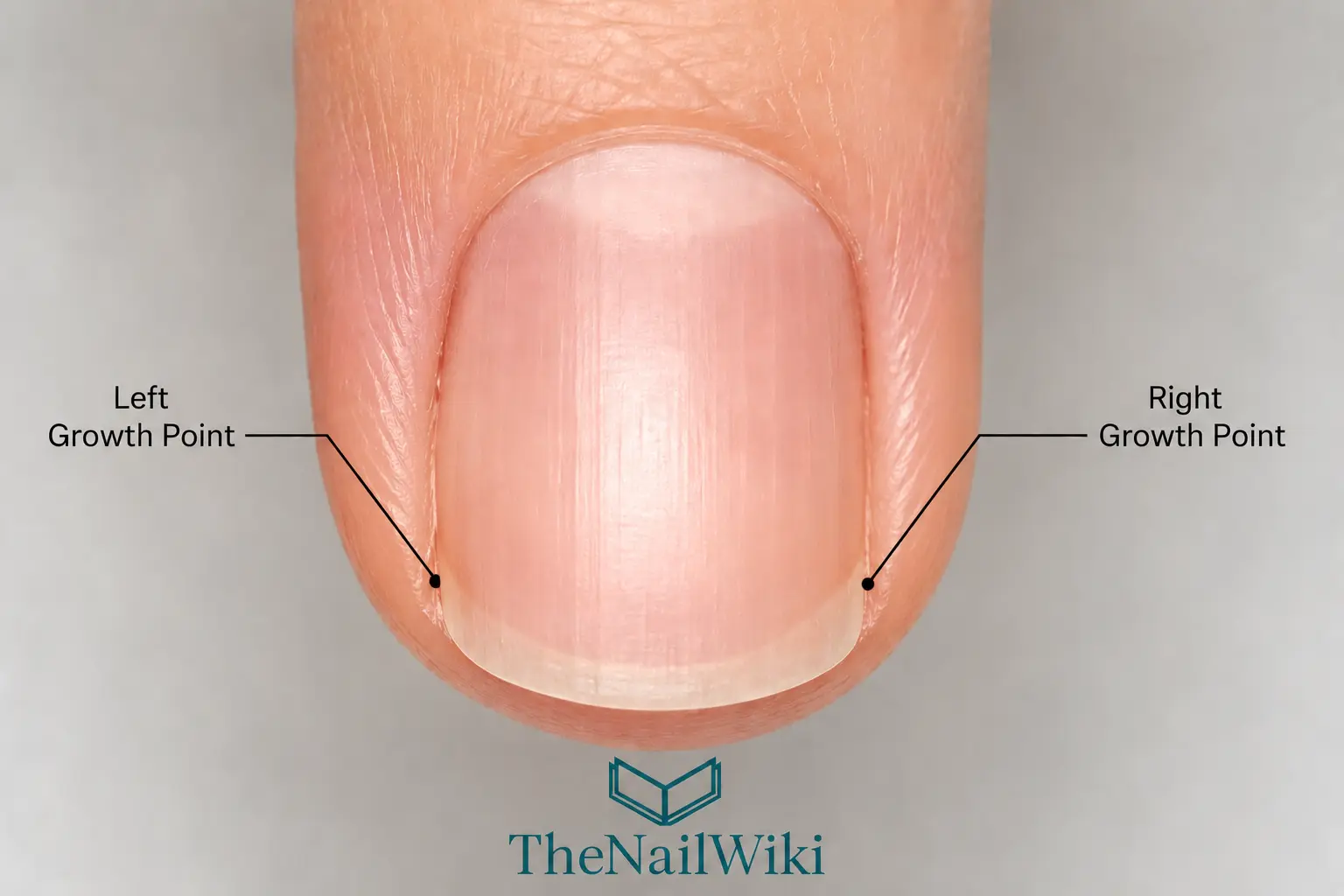
Growth points are the two side corners of the nail plate — one on each side — where the plate transitions from the nail bed into the free edge. They sit at the junction between the lateral sidewall skin and the nail plate, at the point where the nail plate is no longer supported from beneath by the nail bed and begins to separate into the free edge.
The term growth points is used in professional nail practice to describe these specific lateral corner zones — not the nail matrix, which is a separate structure entirely. The matrix (located under the skin at the base of the nail, partially visible as the lunula) is where the nail plate is produced. The growth points are where the already-produced plate makes its transition at the sides from supported to unsupported — they define the shape of the lateral corners and the direction the free edge will take as it grows forward.
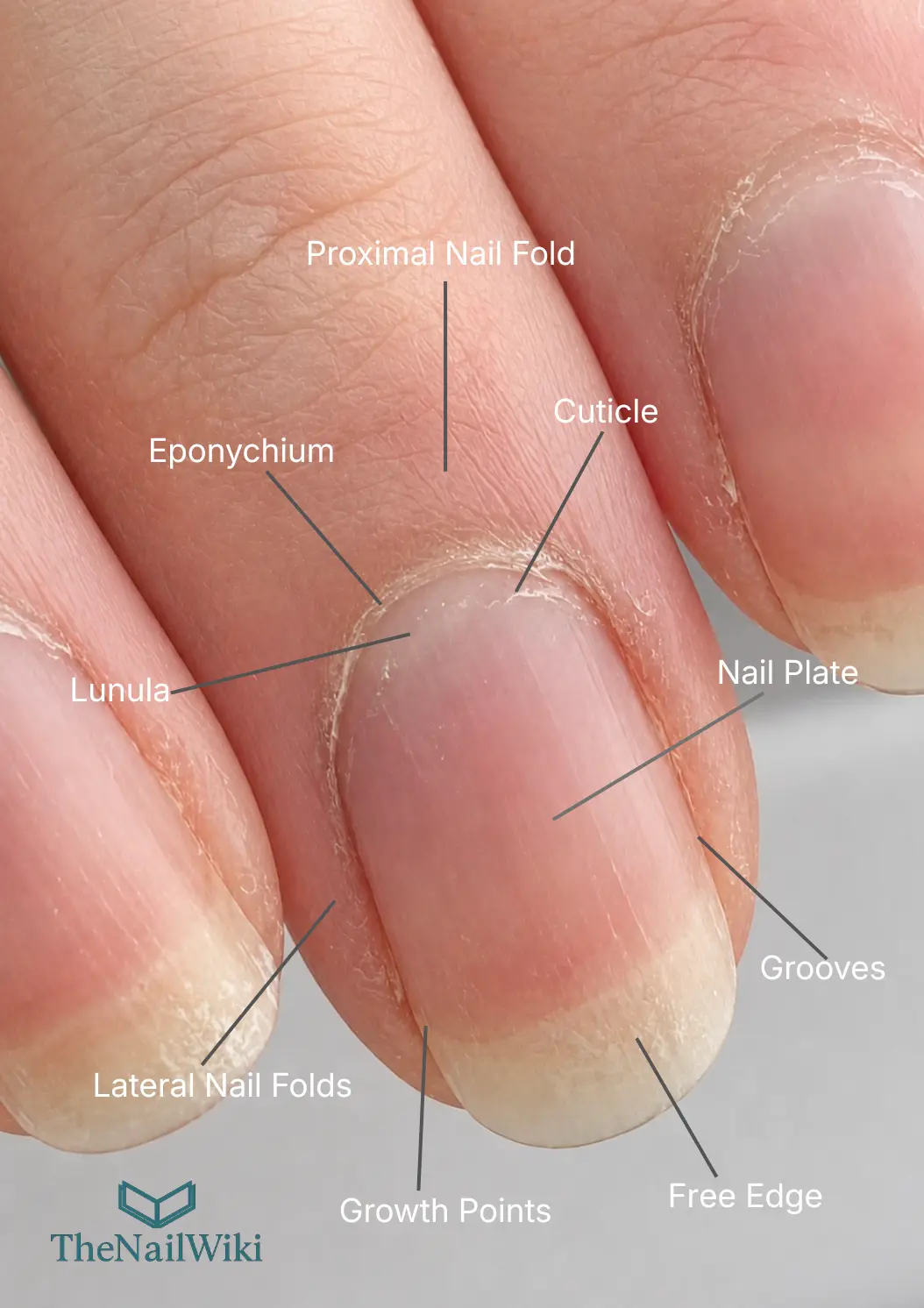
Growth points are closely associated with the lateral nail folds and the lateral nail grooves — the grooves guide the plate edges forward and the growth points are where those edges emerge into the free edge zone. They are also directly related to the nail sinuses — the growth points sit at the distal end of the sinus corners, at the point where the sinus opens and the plate edge becomes the free edge.
Anatomy and Variation Between Clients
© TheNailWiki
Growth points vary significantly between clients in their shape, depth, and position. This variation is one of the most important factors in professional nail assessment — it determines the approach to filing, the form selection for enhancements, and the risk level when working in this area.
High growth points
The plate-to-skin transition at the side occurs higher up the nail — the free edge begins earlier relative to the nail length. These clients tend to have more of the nail plate sitting above the fingertip skin and a more pronounced lateral corner. High growth points are more exposed and more vulnerable to accidental filing.
Low growth points
The plate-to-skin transition occurs lower — the free edge begins later relative to the nail length. More of the plate is supported by the bed for longer before it separates. Low growth points are often more recessed within the sidewall fold, making them harder to see and assess but also more protected from accidental contact.
Rounded growth points
The plate curves smoothly into the free edge at the corners. This natural rounding means the lateral edge does not form a sharp corner — it transitions more gradually. Rounded growth points are more forgiving for shaping and tend to produce naturally oval or round free edge profiles.
Angular growth points
The plate meets the skin at a more defined corner angle. Angular growth points are associated with squarer natural nail shapes and require more careful attention during filing — the corner is more defined and more easily compromised by incorrect file angle.
© TheNailWiki
Structural Role — Why They Matter
The growth points are structurally significant because they define the lateral width and corner shape of the nail plate at the transition zone. The nail plate derives much of its lateral strength from the integrity of these corners — they are the last points of lateral support before the plate becomes the unsupported free edge. The stress zone — the area most prone to breakage — runs across the nail at approximately this level, and the growth points are the lateral endpoints of that zone.
When the growth points are healthy and correctly shaped, the stress zone has full lateral support and the free edge cantilevers forward symmetrically. When the growth points are damaged, filed into, or compressed by incorrect form fit, the lateral support at the stress zone is reduced — the nail breaks more readily at the sides and may grow with a progressively irregular edge as the plate follows an altered path through the damaged zone.
In dual form and enhancement work, the growth points are the most critical assessment points for form selection. A form must fully enclose both growth points without compressing them — if the form sits incorrectly at the corners, the enhancement has no structural support at its lateral base. See: Dual Forms →
How Growth Points Are Damaged
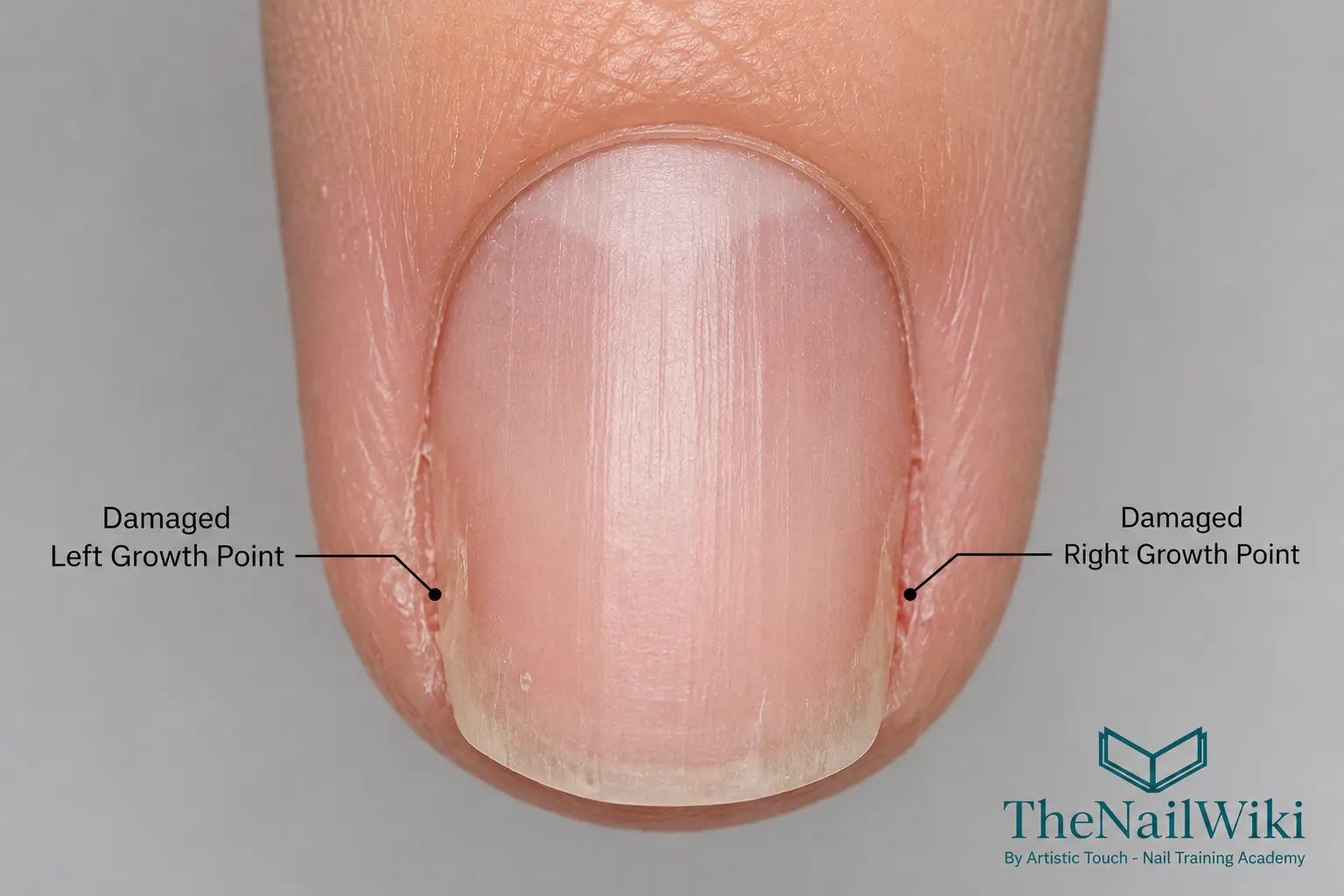
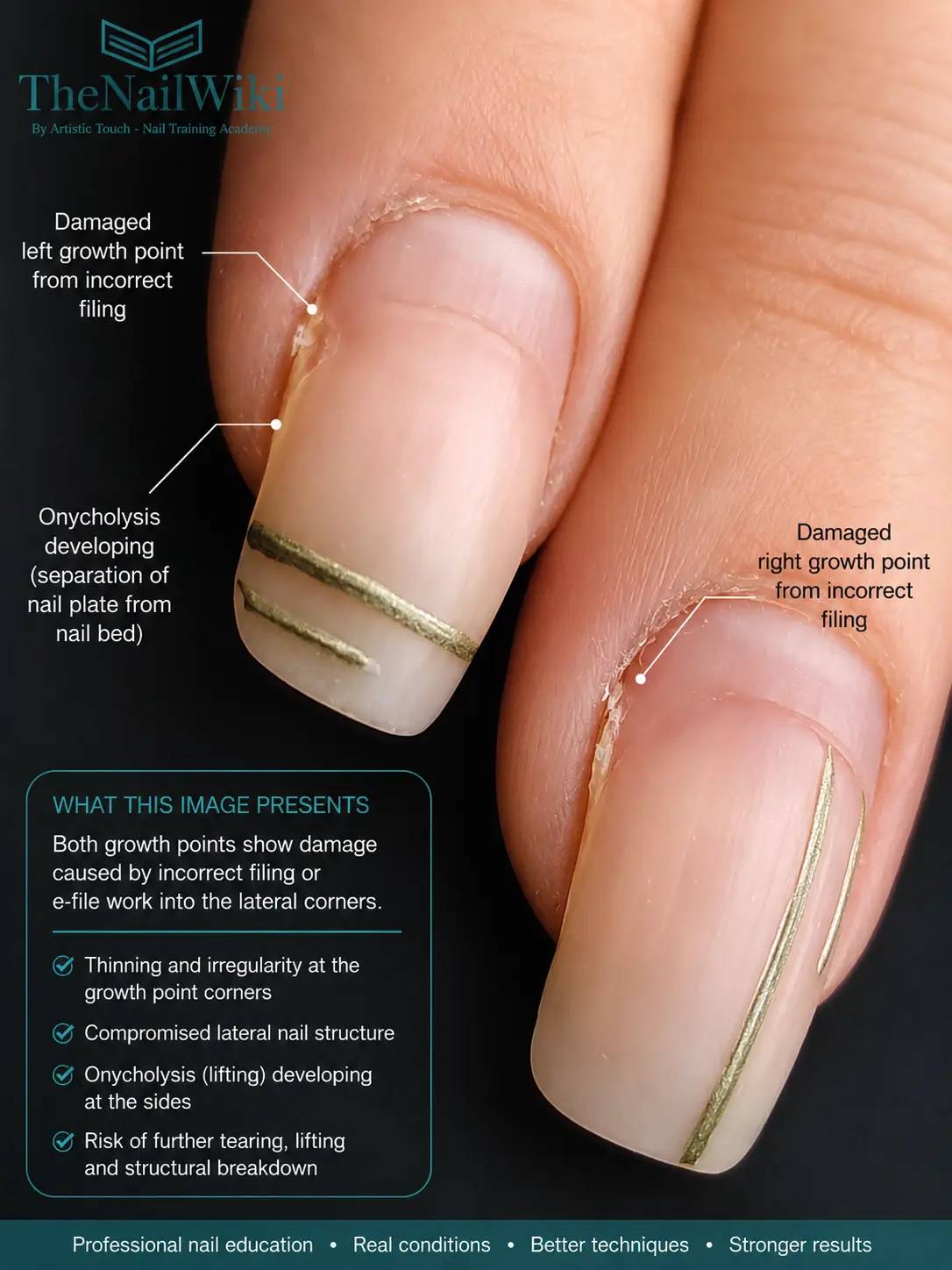
The growth points are among the most frequently damaged areas in nail practice — both in professional services and by clients filing their own nails at home. The damage is often gradual and cumulative, occurring over multiple sessions before the consequences become visible in the plate.
© TheNailWiki
Incorrect filing angle at the sides
Filing into the growth point corners — angling the file towards the plate at the sides rather than parallel to the sidewall — progressively removes material from the lateral corners of the plate. Over multiple sessions this creates a notch at each growth point, weakening the lateral corner and altering the shape of the free edge as it grows forward. The nail becomes thinner at the sides and more prone to splitting and tearing at the corners.
E-file over-filing at the growth point zone
Using an e-file in the growth point area without correct technique causes rapid damage. The e-file removes material faster than a manual file and gives less tactile feedback — by the time the technician senses resistance has reduced, significant thinning may already have occurred. Bits must not be used directly on the growth point corners. This area should be left alone or approached with extreme care and the correct bit at a very shallow angle.
Incorrect dual form fit compressing the corners
A dual form that is too narrow for the nail compresses the growth points as it is pressed over the nail. This creates pressure on the lateral corners of the nail plate during curing — potentially altering the plate’s growth direction at the corners and causing lifting and structural weakness at precisely the zone where the enhancement needs most support.
Cutting the corners too short during shaping
Shaping the free edge by cutting back the corners to achieve tapered shapes on a nail with insufficient length removes material from the growth point zone directly. The re-growing nail plate must find its way back into the lateral groove without a corner to guide it — a common initiation mechanism for ingrown nails. See: Free Edge — Nail Shape and Structure →
Growth Points in Professional Nail Services
The fundamental rule — leave them alone
The most important professional principle regarding growth points is straightforward: they should not be filed, drilled, or directly worked on. Filing and shaping are directed along the sides of the free edge and across the tip — not into the growth point corners. Product application approaches the corners but does not flood into the growth point zone. E-file bits do not contact the growth point corners directly.
This is not because the growth points are untouchable — it is because they do not require direct intervention in a correctly executed service. When preparation and shaping are done correctly, the growth points are simply the corners of the nail that the service works around, not areas that need to be addressed directly.
Assessment before enhancement services
Before applying any enhancement — dual form, hard gel, or extension — the growth points must be assessed as part of the pre-service nail assessment. Their position, shape, and height relative to the nail plate determine the form shape, c-curve depth, and size required. A form that does not match the growth point geometry will not sit correctly — and no amount of technique after the form is placed will correct a fundamental mismatch at the corners.
Product application and the growth points
When applying gel, BIAB, or any enhancement product, the application must approach but not flood the growth points. Product that flows onto the skin at the growth point corners — and remains in contact uncured — is a direct pathway to contact sensitisation. Product that cures against the skin at the growth point creates a rigid adhesion that causes lifting and can physically pull on the skin as the nail grows forward.
Nail Shapes and Growth Points — Why Length Matters
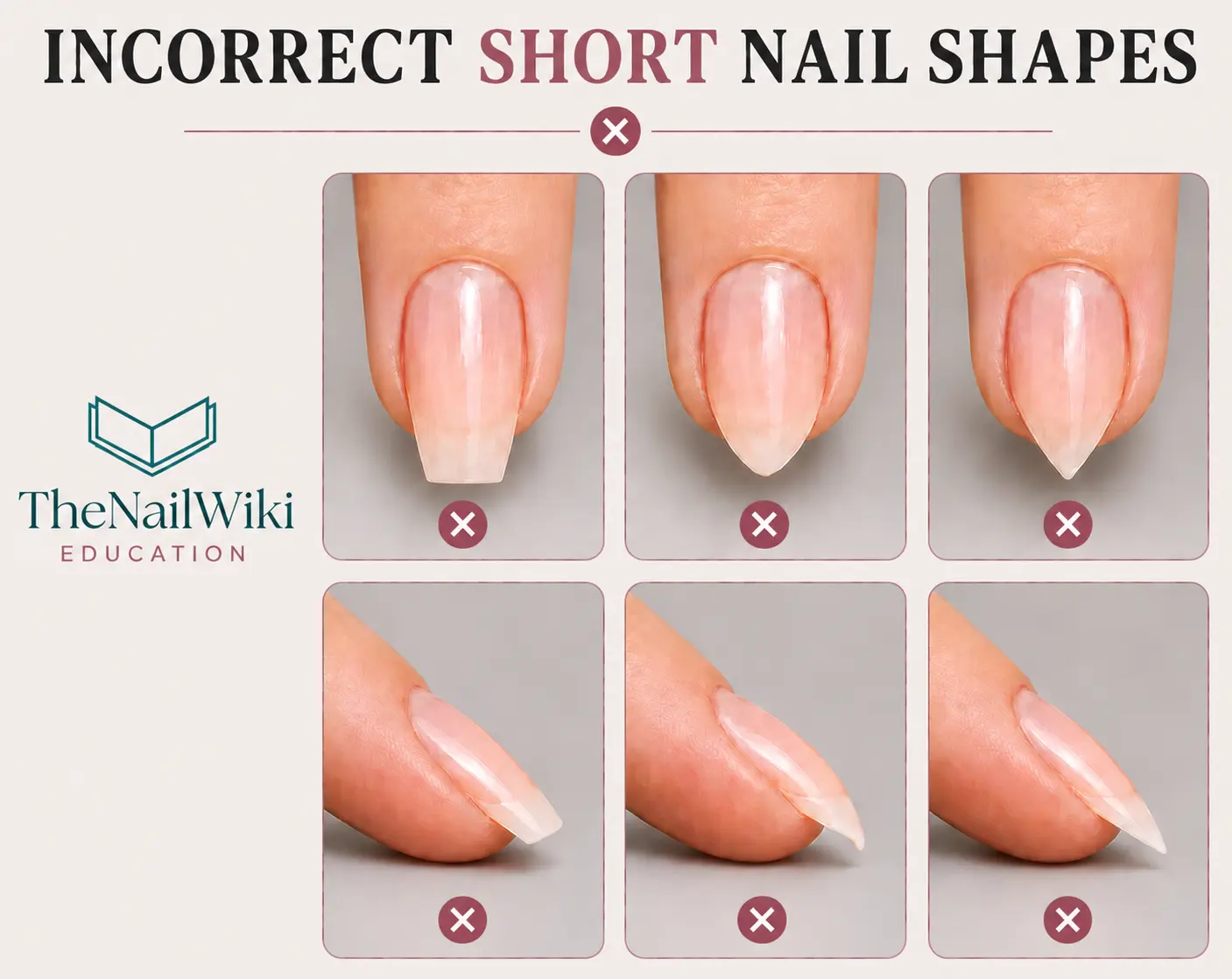
The relationship between nail shape and growth points is one of the most misunderstood aspects of nail shaping. Tapered shapes — almond, stiletto, coffin — require the sides of the nail plate to be filed back progressively towards the tip. On a nail with sufficient free edge length, this tapering begins well forward of the growth points, and the corners retain their full width and structural integrity at the transition zone. On a short nail, there is no length to work with — the taper must begin at or very close to the growth points themselves.
This means the file must be directed into the growth point corners — removing material from precisely the zone that provides the lateral structural support of the nail. The growth points are weakened, the stress zone loses its lateral support, and the resulting shape is not structurally viable regardless of how carefully it was produced. The nail will break repeatedly at the corners, the growth points will become progressively more damaged with each reshaping, and the risk of lateral onycholysis increases as the growth point zone is repeatedly compromised.
© TheNailWiki
The side-view images of incorrectly shaped short nails make this visible — the sides have been filed to almost nothing at the corners. From above the shape looks complete. From the side, the growth point zone has been effectively removed. There is no structural material left at the lateral stress points to support the nail during daily use.
Tapered shapes require free edge length so that the taper begins forward of the growth points — not at them. Without that length, the shape is not achievable without structural compromise. The correct approach is either to build extension length using enhancement product before shaping, or to advise the client on shapes that are structurally appropriate for their current nail length — square, squoval, or oval being the sound choices for shorter nails. See: Free Edge — Nail Shape and Structure →
What Happens When Growth Points Are Left Exposed in Enhancement Services
In dual form, Sandwich Dual Form, BIAB, polygel, and builder gel services, leaving the growth points exposed means the enhancement product does not fully cover and reinforce the lateral structural zones of the nail. The product stops short, leaving part of the natural nail uncovered at the critical side stress areas — precisely where force transfers from the rigid enhancement into the natural nail plate.
This typically happens when the form is too narrow and does not seat correctly at the corners, when product placement does not reach the full width of the nail, or when the result is not checked for lateral coverage after form removal. The outcome in each case is the same — a rigid enhancement structure attached to a partially unsupported natural nail foundation.
The structural consequences
Step fracture at the transition point
Dual forms and structured overlays create thickness and rigidity. When the product ends before the growth points are fully reinforced, a mechanical step is created between the hard enhancement and the weaker exposed natural nail. As pressure travels through the free edge during daily use, force concentrates directly at this transition point — the natural nail often cracks horizontally exactly where the product coverage stops. This is one of the most consistent structural failures in enhancement services and is almost always the result of incorrect form fit or insufficient lateral coverage.
Sidewall stress cracking
The natural nail continues to flex during normal movement, while cured gel or builder gel remains comparatively rigid. When the lateral structural zones are not fully reinforced, stress accumulates at the boundary between the enhancement and the exposed nail plate. This leads to sidewall cracking, splitting near the lateral grooves, product fractures at the edge, or separation of the overlay from the nail plate beneath it.
Catching and premature lifting
Exposed lateral edges create catching points where hair, fabric, or everyday objects pull against the product edge. This repeated mechanical stress progressively weakens adhesion and leads to lifting or complete detachment of the enhancement. In more severe cases the enhancement can tear away layers of the natural nail plate at the growth point corner during impact.
Cumulative damage from repeated exposure
A single service with exposed growth points causes damage that typically recovers as the nail grows out. Repeated services where the growth points are consistently left uncovered cause cumulative damage at the same lateral corner zone each time — the nail plate becomes progressively thinner, weaker, and more prone to onycholysis at the sides. This damage takes significantly longer to resolve than a single incident and may permanently alter the quality of the nail plate at the growth point zone.
Why growth point coverage matters structurally
The growth points are part of the nail’s structural support system. Correct lateral coverage allows force to distribute smoothly from the enhancement into the natural nail rather than concentrating pressure into one exposed transition area. This is why professional structure work addresses not only apex placement but also sidewall reinforcement, smooth structural transitions, and correct lateral coverage — closing the growth points is as important as building the apex.
In dual form and Sandwich Dual Form services, the form must fully enclose both growth points before product is applied or the form is pressed. If the form does not seat correctly at the corners, it must be replaced — there is no technique adjustment that compensates for a form that does not reach the growth points.
In builder gel and polygel services applied without a form, product must be taken fully to the lateral corners of the nail. After curing, coverage at both growth points should be checked visually before any finishing work begins. A gap at either corner is a structural defect that must be corrected — not filed smooth.
Recovery From Growth Point Damage
Damage to the growth points heals slowly — the affected area of nail plate must grow out completely before the corners return to their undamaged profile. Because the growth point is at the lateral mid-point of the nail length, the plate at that zone takes approximately three months to travel forward to the free edge. Severe or repeatedly damaged growth points may take longer to show improvement.
During recovery the most important steps are:
- Stop all filing and shaping that contacts the growth point corners
- Avoid aggressive e-file work in the sidewall zone on the affected side
- Keep the corners clean — debris accumulation in a damaged growth point zone promotes infection
- Apply cuticle oil daily to the sidewall and growth point area — hydrated skin and nail plate recover more effectively than dry tissue
- Allow the nail to grow at a shorter length while the growth point zone recovers — less free edge length reduces mechanical stress on the damaged corner
Irritated or inflamed growth points — presenting as redness, swelling, or tenderness at the lateral corner — should be assessed for infection before any nail service continues. Applying product over an inflamed growth point is not appropriate.
Frequently Asked Questions
What are growth points on nails?
Growth points are the two corners on either side of the nail where the nail plate transitions from the nail bed into the free edge — where the plate meets the skin at the sidewall and begins to separate from the underlying tissue. They define the lateral corners of the nail and its natural shape at the sides.
Are growth points the same as the nail matrix?
No — they are completely different structures. The nail matrix is where the nail plate is produced, located under the skin at the base of the nail. The growth points are where the already-produced plate transitions from the nail bed into the free edge on each side. The matrix produces the nail. The growth points are where the nail makes its lateral transition to the free edge.
Why should growth points be left alone during nail services?
The growth points do not require direct filing or drilling in a correctly executed service — they are corners the service works around, not areas that need intervention. Filing into the corners or applying e-file bits directly to the growth point zone causes thinning, irregular growth, and onycholysis at the sides. Leaving them alone is not a limitation — it is correct technique.
What happens if growth points are damaged?
Damaged growth points can cause the nail plate to grow irregularly at the sides, become more brittle and prone to splitting at the corners, or develop onycholysis at the lateral edges. Recovery requires stopping all direct work in the area, keeping the corners clean, applying cuticle oil daily, and allowing the affected plate to grow out — which takes approximately three months or more.
Do growth points vary between clients?
Yes — significantly. Growth points vary in height (high or low relative to the nail length), shape (rounded or angular), and depth. This variation directly affects form selection in enhancement work, the appropriate shaping approach, and how much care is needed in the sidewall zone during preparation and filing.
Professional training in nail anatomy and enhancement technique
Growth point assessment, form selection, and nail shaping technique are taught as part of structured professional courses at Artistic Touch Nail Training Academy.
Related Library Pages
Nail Anatomy
- → Nail Plate
- → Nail Bed
- → Free Edge
- → Lateral Nail Folds
- → Lateral Nail Grooves
- → Nail Sinuses
- → Nail Matrix
- → Stress Zone
Enhancement
Conditions
Some linked pages are currently in development and will be published progressively.
Professional Disclaimer
The information on this page is provided for educational purposes and is intended to support the professional knowledge of nail technicians and nail educators. It does not constitute medical advice.
About the Author
Radina Ignatova
Professional Nail Expert | International Nail Educator
Radina Ignatova is a Professional Nail Expert since 2014, International Nail Educator, and Founder of TheNailWiki and Artistic Touch Nail Training Academy. She specialises in Russian Manicure, dual form systems, polygel, advanced e-file techniques, and nail safety protocols, and continues to work actively in salon practice ensuring that all education reflects real client scenarios and current industry standards.
Her teaching philosophy is built on honest education — showing real salon challenges, real mistakes, and real performance testing rather than presenting only perfect demonstrations. This is how genuine technical competence is developed and how nail professionals become truly confident and capable.
Read full bio →© 2026 TheNailWiki — an independent nail education resource. Content is safety-led and professionally informed.