
Why Damage at the Nail Matrix Shows Up on the Nail Weeks Later
Quick Answer: Why Does a Mark Appear Weeks After an Injury?
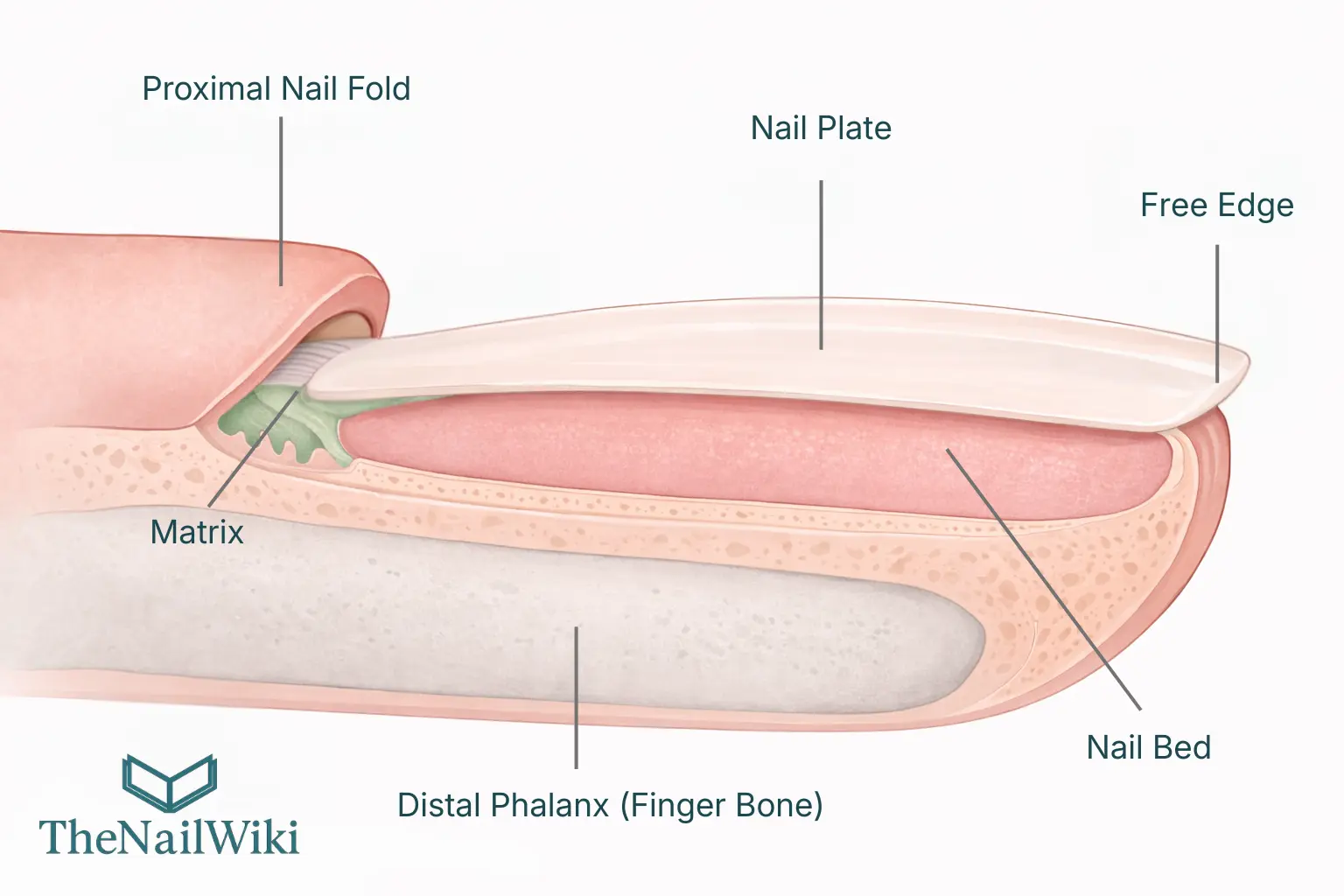
Marks, ridges and changes of texture appear on the visible nail long after the event that caused them, because the nail matrix forms the plate beneath the skin and the plate then has to grow forward before the change can be seen. A fingernail advances roughly 3 to 3.5 mm per month, and a complete fingernail takes about six months to grow from the matrix to the free edge. A client who notices a white mark or a groove today may therefore be seeing the result of something that happened weeks earlier.
Why it matters: a mark that arrives some time after an appointment is easily blamed on the most recent service, while the true cause may lie further back.
Why There Is a Delay
The matrix is living tissue at the base of the nail unit, tucked beneath the proximal nail fold. Every cell in the plate originates there, and once a cell is part of the plate it is inert. What the matrix produces at a particular moment is therefore fixed into the plate at that moment and carried forward with it.
This has two consequences. First, a disturbance of the matrix is recorded in the plate like a mark on a moving belt, and it travels towards the free edge at the speed of nail growth. Second, the visible nail does not show the matrix directly. Only the lunula, where visible, indicates its position, so what the technician sees is always a record of the past.
Growth reference
- Fingernails grow about 3.0 to 3.5 mm per month in a healthy adult.
- A complete fingernail takes roughly six months to grow out from matrix to free edge.
- Toenails grow about 1.5 to 1.6 mm per month and take 12 to 18 months.
- Growth slows with age and may slow temporarily during illness, nutritional deficiency or poor circulation.
Reading a Mark by Its Position
Because the plate moves at a roughly steady rate, the position of a mark gives a rough guide to timing. A mark close to the base of the visible nail emerged recently, and one nearer the free edge is older. Dividing the distance travelled by the monthly growth rate gives an approximate age for the mark.
This estimate should be treated with caution for three reasons. The part of the plate hidden beneath the fold adds a further delay before a change becomes visible. Growth rate varies between individuals and fingers. And growth can slow during illness, which stretches the timeline. The method is useful for giving a client a plausible account, and it should not be presented as an exact date.
What Different Changes Can Indicate
White marks after trauma
White marks that appear after a knock, or after aggressive work near the base of the nail, are often a result of disruption to the matrix as the plate was forming. They are embedded in the plate, not on its surface, and they cannot be buffed out. They grow forward with the plate and eventually leave at the free edge.
Transverse grooves
During significant illness the matrix may slow or temporarily reduce its output. The thinner section of plate that results appears later as a transverse groove, known as a Beau's line, as growth resumes and the thinner band travels forward. A groove that crosses several nails at a similar position suggests a systemic cause rather than a local injury, and it is worth mentioning to the client.
Changes in texture, ridging or brittleness
Nutritional deficiencies, including protein, iron and certain vitamins, can reduce the quality of matrix output and produce brittle, ridged or weak plates over time. Because these changes develop gradually, they are not usually attributable to a single appointment.
Longitudinal ridges and splits
A persistent ridge or split that runs the full length of a nail and has been present for years is frequently the result of old matrix scarring. It is not a product problem or a preparation problem, and it will not respond to a change of technique. Recognising this prevents the technician from attempting to correct something that cannot be corrected at the service level.
Temporary Disruption and Lasting Damage
The outcome depends on how much of the matrix has been disturbed.
- Temporary disruption: a single impact, a period of illness or a short reduction in blood supply produces a thinner, softer or irregular section of plate. When the cause resolves, normal production resumes, the affected section grows forward and out, and the plate returns to its earlier quality.
- Scarring: deep trauma, burns, surgery, chronic inflammatory disease or repeated aggressive mechanical injury can leave scar tissue that does not produce normal plate cells. The result can be a permanently ridged plate, a split or thinning that does not resolve.
Protecting the Base of the Nail
The matrix extends further back beneath the proximal nail fold than many people realise. Tools, files or pressure applied close to or beneath the fold are working near living matrix tissue. Heavy filing, cuticle cutting or product application that reaches deep into the base area deserves particular care. The article Working Near the Lunula: Why the Base of the Nail Calls for Restraint explains why this area needs care, and The Proximal Nail Fold and Safe Cuticle Work covers what is safe to touch.
Habits matter too. Biting and picking at the nail base can damage the proximal fold and expose the matrix, and clients presenting this way often feel anxious or embarrassed. A calm, factual explanation of the growth timeline is often the most reassuring thing a technician can offer.
When to Refer
⚠️ Changes that need assessment
Any new, unexplained or progressive longitudinal change in a single nail warrants referral for medical assessment, particularly if it involves pigmentation, because some serious conditions can present in this way. A change that develops quickly, is painful, or is accompanied by swelling or signs of infection should also be assessed. See contraindications in nail services.
Talking With the Client
- Explain that the visible nail is a record of what happened weeks or months earlier.
- Give an approximate timeline using the monthly growth rate, and make clear that it is an estimate.
- Do not promise that a mark can be removed. Embedded marks leave only as the nail grows out.
- Avoid attributing the mark to the latest service without considering the timeline.
- Keep a record, ideally with photographs, so that changes can be followed.
Frequently Asked Questions
Why did a white mark appear weeks after I hurt my nail?
The injury affected the matrix as the plate was forming. The affected part of the plate has taken time to grow forward into view.
Can a white mark be buffed out?
No. It is within the plate, not on its surface, and it leaves only as the nail grows out.
How long will it take to disappear?
A fingernail takes roughly six months to grow from the matrix to the free edge, so a mark near the base may take several months to leave completely.
What is a Beau's line?
A transverse groove formed when the matrix slows its output, for example during significant illness. It appears later as the thinner band of plate grows forward.
Is a ridge down the nail caused by my products?
A long-standing ridge that does not change is frequently the result of old matrix scarring rather than product or preparation. A new or changing ridge in a single nail should be assessed medically.
Related Library Pages
- Nail Matrix
- Lunula
- Proximal Nail Fold
- Nail Plate
- Nail Growth Cycle
- Fast vs Slow Nail Growth
- Nail Haematoma Types